

IL GATTO
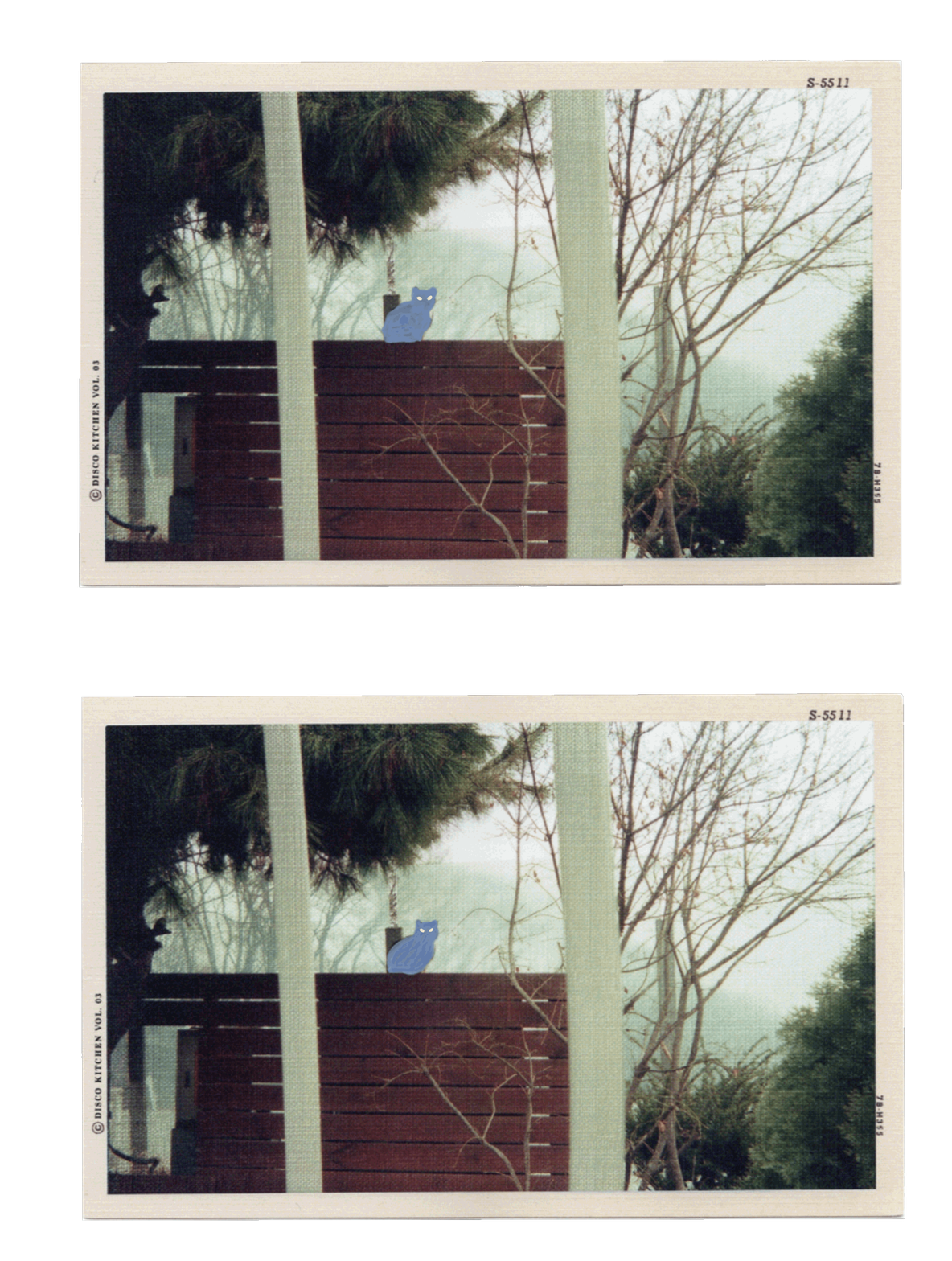
by Gina Angelone
Three used history books and six fresh bagels. The books are to feed his hunger. The bagels are more of an abstraction. A misconception of the w/hole. Because no matter how much history we ingest, no matter how well-rounded our view, facts are always missing. Core facts. Bagels are conceptual that way. So are my visits.
I open the door as Dad is flipping channels between the Christian Miracle Network and Off-track Betting. One way or another, he’s hoping to get saved.
“La vagabonda.” His deadpan announces my arrival to the flatscreen.
“Come sit. A little mass won’t kill ya. Your mother stepped out to run errands. We got time.”
Funny. I don’t ever see our time together as surplus. Only as deficit. But with Mom not home and his programs on, he’s found an opportunity for indulgence. Like the kind of happy, empty minutes one feels while standing in line for ice cream. People waiting around for mint chip have extra time. People with pancreatic cancer don’t. I hear myself say, "Sure, Dad." But I predict a shortfall of something sweet before I get my Sunday.
I place the bag with books and bagels at his feet. A sacrifice at his altar.
The televangelist, sweat popping through his sharkskin, sails around the church with blinding faith and false teeth. He glistens with a kind of coin-operated fervor. In spite of his dubious sheen and dentistry, he can still spit promises of eternity from one hundred feet away.
“I can’t believe you watch this stuff, Dad.”
“Given my current situation, sweetheart, I thought I should take a refresher course. You know. Re-up my commitment.”
“Last minute brownie points? Can’t hurt, I guess.” I flop in the armchair, bracing myself for some hellfire and damnation.
“What’s in the bags?”
“History books and bagels.”
“Scripture and Eucharist. Just what the doctor ordered.”
“Do you want one?”
“Not now.” He leans into the airwaves. “This is the best part.”
His eyes half close, receiving the sermon like a warm compress on an aching head.
Until this recent death sentence, Dad’s faith only consisted of stringing colored lights at Christmas and making sure we had the finest tree a lumberman could procure. Mom’s zeal took place in the kitchen, making versions of the Last Supper. Except in her book, Jesus and the apostles were having lasagna.
Gambling was probably the closest thing to true religion in this house. Ricky and I took to it like Baptists to water. More than the thrill of the horses or the pockets full of money, it was being in our father’s inner sanctum that made those days so holy. We looked forward to squandering a portion of Mom’s dreams, winning a few glorious races, arms punching the air in victory, lightbulbs snapping like fireflies in the winners’ circle. Mostly, we’d lose. But the winning or losing didn’t matter so much. What mattered was our devotion. So when Dad asked me to take him to the track again, just once more, just the two of us, it brought me to my knees.
That was ten Sundays ago.
He reaches for the control and silences the glossy preacher. The calm feels as comforting to me as toasted bread.
“Next time, I’ll stick with OTB.” He lowers his voice as if angels were spying. “More dependable. You know what I’m sayin’?”
I do know what he’s saying. No use praying for miracles that won’t happen: absolution from family, a hall-pass from God, remission. Sometimes, the only pearly gates you can count on are the ones that open before post time.
“Luckily," I offer, "you get to choose any place of worship you like.”
“True. So, if you don’t mind me asking, sweetheart: What’s yours?” He gives me a leftover churchy glare.
Maybe at the heels of Nike of Samothrace. Or in front of La Pieta. Art has always been my place of worship. But now, with illness and the famine of time between us, the truth has shifted. I shrug and hand him an everything bagel.
He tosses it in the air a few times, poppy seeds and bits of dried onion and garlic falling onto Mom’s clean carpet. Then he stuffs it in his robe.
“Dad, what are you doing?”
“Thinking about balls.” He pats his pocket.
Though the question is on my lips, I only manage a squint.
“More precisely, thinking about the last time I played with one. Seems like a lifetime ago. When I was a kid, I’d prowl around looking for rubber balls in the gutters. Gianelli, the local roofer, called me The Cat. He’d yell ‘Il Gatto! Vieni qui’ and then toss me a ball from the drainpipe. I was a wiry son-of-a-gun back then. Ma used to go crazy when she’d catch me scrambling over rooftops. I told her not to worry: Even if I fell, I had eight more lives. Then I’d lift one leg in the air just to hear that Oooooo sound she made when she was nervous.”
“What did you do with all those balls? Stuff them in your pockets?”
“Damn straight. I needed them. You couldn’t keep me from playing stickball in the streets or handball against the back of the house. Sometimes I’d smack the ball so hard, the shutters would slip off the windows. It drove my Pop nuts.”
“Did Nonno ever play with you?”
“You kidding? With nine mouths to feed, he had no time for nonsense. My brothers had to put in long hours at the bakery after school, shoveling coal and making deliveries. They hustled hard. And Pop kept going until he was too sick to work anymore. The doctor used words like advanced and aggressive and then left a pamphlet about quarantines on the kitchen table. Everyone thought it was contagious. Only Ma was allowed in that room. I was so young. I didn’t understand what was going on. I’d press my ear against the door just to hear him breathing. I swear, I never heard such a terrifying sound.” He shudders for effect.
I picture my grandfather’s big black mustache heaving up and down over his wheezing mouth like a vulture over its prey.
“I couldn’t understand why they wouldn’t let me see him or climb up on his knee like I always did and smell the flour on his clothes or dig in his pockets for a warm roll. He’d always put one there for me.” Dad reaches in his robe and pulls out the bagel like a memory. “I was on the Cicciones’ roof the day he died. I heard Ma wailing from across the street. She hung a big, black mourning crepe on the wall so everyone would know he had passed. The whole neighborhood poured into the house. Suddenly, anyone could enter the room and see my Pop laid out—empty and deflated in a casket that looked like a gutter pipe.
“I stood there with my brothers and squeezed the ball in my pocket until I felt some heat. Then I went outside and heaved it at that crepe as hard as I could. It fell on the ground in a heap. Ma heard the noise and saw what I’d done. That was the only time she ever raised a hand to me. After that, I wasn’t allowed on the roofs anymore. And I had to go work with my brothers in the bakery. I lost everything that day.”
“I’m really sorry, Dad. I never knew that.”
He takes a bite of the bread. “My old man never wanted to be a goddamn baker.”
“But that’s all he ever did.”
“He wanted to build things. Construction. Houses. But that took money. It was a lot easier buying flour than cement. That’s the human fucking condition, I guess. You spend your whole goddamn life dedicated to something you don’t even want to do.”
The space between us grows very quiet. Any attempt at justification might hit the wall, shake something foundational, make unspoken confessions crash to the ground. I hadn’t realized the depths of my inheritance—this legacy of creative dreamers with day jobs. If the bun didn’t fall far from the baker, then maybe the tree doesn’t fall far from the lumberman.
A laugh erupts, his face collapsing into his hands as he howls, drool and delight spilling through the openings of disappointed but giddy fingers. He carries on like a madman for a protracted moment, stretching the pleasure, making time for it. I wait, not sure if I missed something, if I should be laughing too. I hook a smile to my face in case it needs to be unfastened quickly. When there are no do-overs and nothing you’ve desired has been accomplished, and you’ve taken yourself far too seriously, I guess all you can do is laugh at your own shit luck—your own absurd undoing.
“It’s so fucking ridiculous.” He puts a tissue to his face and lets it collect the gush, like a tarp holding back the next avalanche. “Look at me. Locked up here like an old can of meat waiting to expire. Everybody’s expecting the call: Rex is dead. Just like they did with Pop. No different. They’re my flesh and blood, yet nobody puts their ear to the door to check if I’m still breathing. No one.”
“Really?” I don’t know how much more I can defend my status.
He looks at me strangely. “I’ll be damned. Except you, Mia. Except you.” The outpouring is drying up under his sockets, turning them into wasteland again. Whatever spark of joy or rush of insight is now another inky smudge on his papery skin.
As he paws through the books I brought with distracted interest, I imagine a rewrite. In my version, young Rex Vittori is skipping the rooftops in his Sunday best, away from all the foreign words and prayers, away from the smell of sugar cookies and old women. He is youthful and self-possessed. Words roll around his brain and he wants to stuff his pockets with them, feel their momentary heat, and then hurl them at the world—let them bounce until the whole goddam story is there as proof. In my version, young Rex is not worried about duty or consequence or big brothers. He’s got time. Time to linger and to burn. With one life suddenly gone, Il Gatto is simply moving on to the next.
Longtime filmmaker and storyteller, Gina Angelone’s film and TV work has been the recipient of international awards and recognition, including multiple Emmy awards and grants from foundations, including the National Endowment for the Arts. Her films have been broadcast worldwide, theatrically released, and have garnered top festival prizes. Gina has been fortunate to tell stories and observe humanity from all corners of the globe and feels her cinematic background informs her fiction writing. As an author, Gina’s work has won various literary competitions and been published in anthologies as well as in many literary journals, both in print and online.