

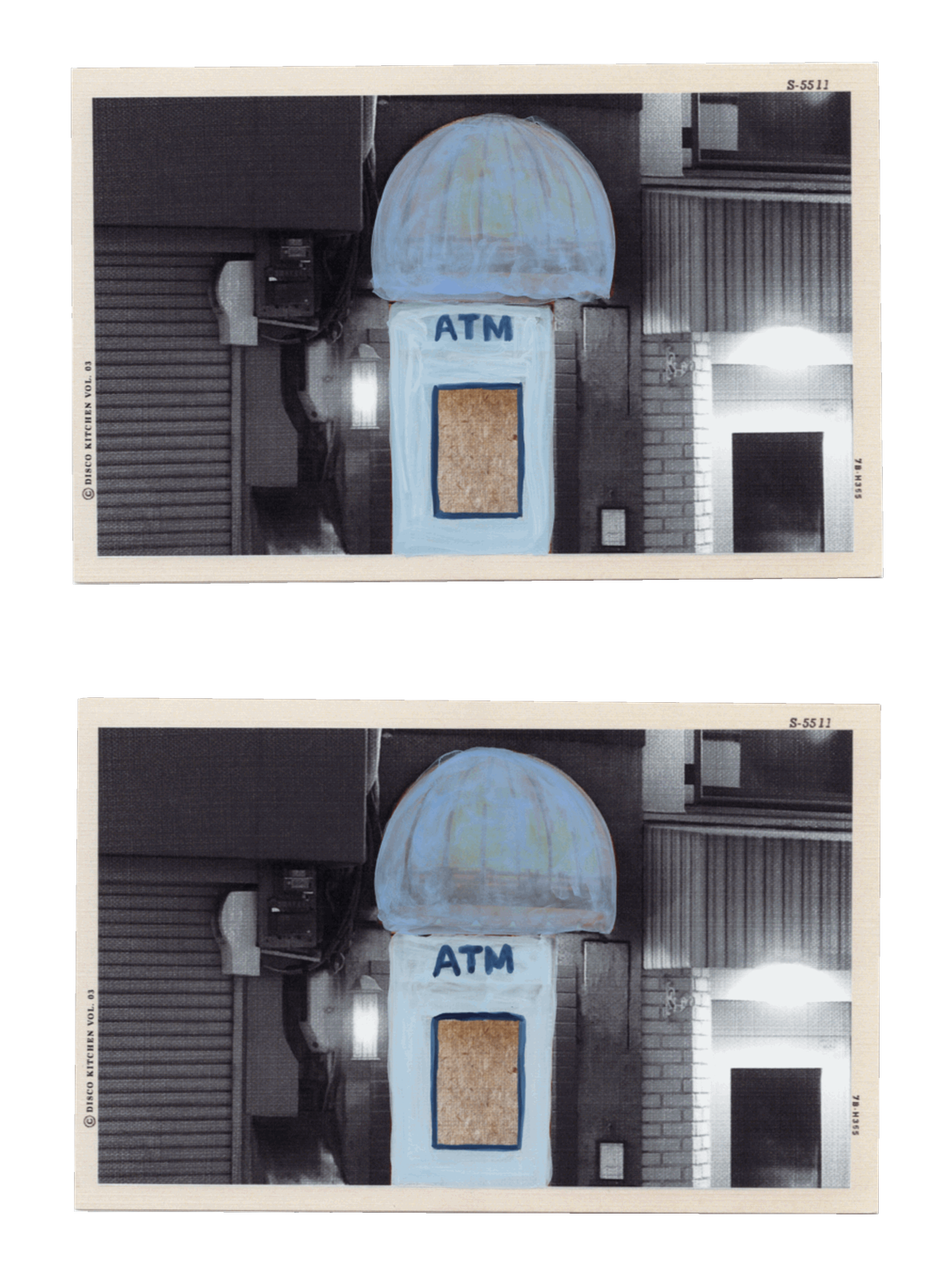
GOSPEL OF THE BROKEN ATM
by Orleans Saltos
My mother's mass maintained its quiet dignity. That is, until the priest the priest announced to the congregation that my mom and her second husband had “hooked up” in front of a Baton Rouge ATM.
The priest said it almost reverently, as if reciting scripture: the gospel of Marlena and Bob’s origin story. His enormous body stood above us, in a white robe that looked like a deploying parachute, leaning on what must have been the sturdiest cane in the South, and declared:
“Marlena and Bob hooked up right there by the broken ATM.”
Obviously, he meant they met, not hooked up. The younger mourners ducked their faces and covered their mouths, shoulders shaking. The older ones blinked peacefully, untouched by this generational linguistic catastrophe.
Then the priest announced that my mother had been “a champion for immigrants.” I swallowed my laugh so hard I started coughing. My mother believed in shutting the door behind her. She was an immigrant, yes. But organizing a welcoming party? Absolutely not. Still, like the priest, she had a gift for crafting the version of herself she preferred or needed at the moment.
My mother was from Ecuador but insisted she was “pure Spanish.” Her father was from Spain and her mother was Quechua. But she erased the maternal half of herself to survive. In Louisiana of the 1960s, surrounded by heat, live oaks, and suspicion, reinvention wasn’t only vanity but an armor. So, she threw herself into southern mannerisms, embraced local tradition, and tried fiercely to be the whitest belle that no one believed she was just to avoid distrust.
Now she lay ten feet away, under a hill of roses. Flawlessly preserved, with less makeup than she would have demanded in life, and still beautiful. She had chosen the coffin years ago: mother-of-pearl, gold-lined with tiny flowers and over-the-top even in death. Above her, a lean, blue-eyed Jesus stared down in eternal disapproval. The Catholic church around us holding her mass felt more like a tract home: plain beige walls, plastic stained glass, and linoleum floors. By the entrance sat a pamphlet display, including one titled What to Do If Your Child Is Gay. I had slipped it into my purse upon my arrival. Not because I needed it, but because my mother would have hated that I had it.
Throughout the service, I fought against a persistent bubble of laughter threatening to escape. I wanted to laugh at the priest for his holy misunderstanding. Laugh at the embellished eulogies and the improvised myth of her generosity. Laugh at the mortician’s tasteful make-up restraint. I half-expected her to sit upright from the satin-lined white coffin, wag a blood-red manicured and accusatory finger at me, and shout: Reina de la basura! Sin vergüenza! Don’t laugh at my funeral!!
Queen of the Garbage. Shameless girl.
She called me that often when I was a rebellious, fully American tomboy. In our family, like many Latino families, nicknames were vicious. My sister was samba huma, drunk curly-headed girl. My dad called my mom vieja, old lady, though she remained oddly youthful to the end. Along with Reina de la basura, I was chata fea, ugly flat face. Once, when I told an older American friend about these nicknames, he took my hand and said, “I’m so sorry.” But I didn’t need sorrow. This was simply the language we spoke.
We were volatile, my mother and me. But when we aligned, we were a force. When my second-grade teacher refused to let me go to the bathroom, I defiantly walked out of school, crossed a major highway, probably passed a few kidnappers, and arrived home to a horrified mother. She stormed back to school, unleashed Spanglish medical theatrics, and announced that my pipí se pudría (my pee was rotting me) and I would die. Maybe they didn't understand her Spanglish and were adequately convinced I had some rare urinary medical condition. Nonetheless, I became the only second grader allowed unrestricted bathroom access.
So that day in the church, when the priest misrepresented her, yes, I nearly cackled many times. Not because it was funny, but because it was wrong. She wasn’t saintly or part of hookup culture. He was telling her story without her permission and embarrassing her. She would have hated that most of all. But she didn’t rise and correct anyone. She stayed quiet, hands curled around a gold-plated cross.
Death was the only thing that could silence her.
When the service ended and I followed her casket outside, I saw my reflection in the glass door. I expected to see myself, but instead, there she was. Her thick dark eyebrows and almond-shaped brown eyes stared back at me. Like her, I was not pure Spanish and something impossible to categorize. Something that survives.
Without moving its lips, that reflection said: Well, you behaved. About time, sin vergüenza.
Orleans Saltos is a Latina writer and artist who grew up between Ecuadorian and Southeastern Louisiana cultures, where humor and heartbreak often sat together at the dinner table. She writes about cultural translation, messy families, and the odd dignity of everyday rituals. She now lives in Berkeley, CA.