

THE DEVIL'S IN THE DETAILS
by Julie Pearson
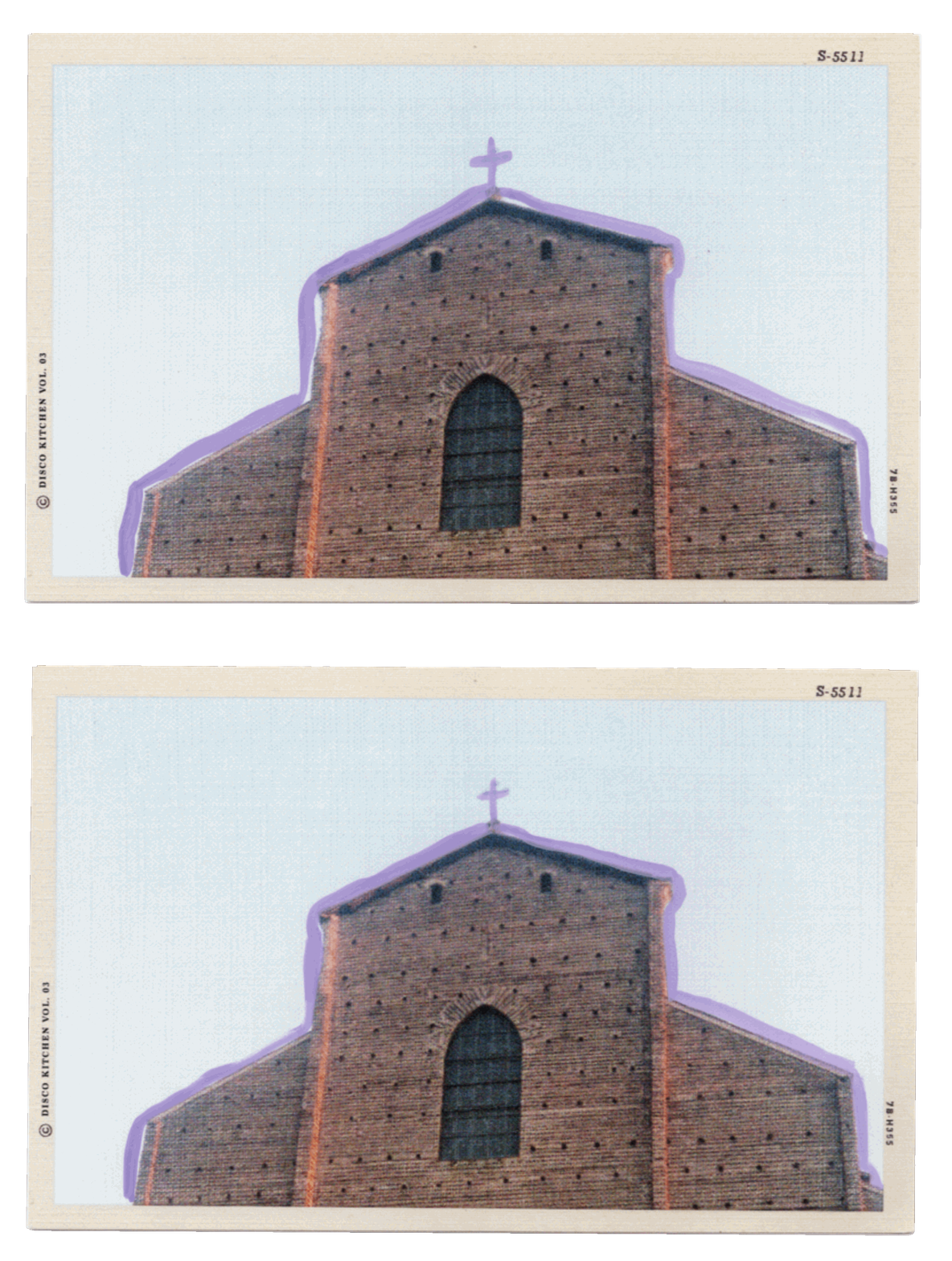
I have this memory that nobody in my life can corroborate. I’m a first grader, at a school assembly in the auditorium with the blue curtains on the proscenium stage. I’m sitting on the floor listening to some visiting group of young adults tell us about the devil. Satan. Lucifer. They’re worked up, they’re impassioned. As a younger kid, I’m sitting toward the front of the crowd, and I can see their wide eyes flashing with trepidation like they’re telling us a ghost story.
I haven’t really heard much about the devil before this moment, but he doesn’t sound great. The thing is, they’re not being very clear about who or what the devil actually is. He sounds like a scary monster.
Until a fourth grader—an “older kid” and therefore an authority figure—raises his hand and says, “The devil killed my dad.” The speakers all go nuts over this, it’s the best thing they’ve ever heard. “Yes he did,” they say. “The devil did kill your dad!”
So at this point, I’m freaking out because the devil sounds like a home invader, a scary human. Like he can just walk into your kitchen and shoot you. Like maybe he could find my family in my kitchen tomorrow. The speakers do nothing to debunk this idea. The assembly ends, and they just send us back to class with our newly minted fears and assumptions. It’s never spoken of again.
But nobody who was in my life at the time can verify that this happened. It’s a memory I recovered sometime in college, and it’s so vivid that I can’t believe I could have made it up.
When I was really young, my parents moved from Minneapolis to St. Paul for better schools, and ended up buying a house one block outside the district of the public school they meant to send me to. So instead, I ended up at Nativity of Our Lord Catholic school on the logic that, well, it was close by. But the twist is: my family is not Catholic. So for nine years, from kindergarten through eighth grade, I pretended.
When I went to my first day of kindergarten, I was worried about a lot of things: making friends, learning new things, wearing a uniform for the first time. But I didn’t expect to be accosted by all these prayers and hand signals (i.e. the sign of the cross) that everybody else seemed to just know. My mom bought me a little prayer book, and I studied it—religiously?—trying to fill in the gaps.
My family did have a church of our own that we went to, and it was even a Christian one! It was on the campus of a liberal arts college, and the weekly bulletin stressed that “All are welcome.” This was 1990’s code to let people know that the church was okay with gay people, I later learned. I thought it was nice that they specifically stated that everyone was allowed in, regardless of what religion you technically were. We went to church sometimes. My mom generally felt like we got enough religion at school, so we didn’t go that often. I grew up thinking that Protestants didn’t have to go to church in the summer because, well, we didn’t.
I was baptized, but I wasn’t baptized Catholic, and that is the first of the seven sacraments. They’re like levels in a video game, or a multi-level marketing scheme: You have to beat the first one before you can move on to the next. And while I was stuck at level one, a lot of those future levels took place during school hours.
So in second grade, everybody else prepared for their First Communion. If you don’t know, in Catholicism, communion is the blessing of a host—a little cracker—and some wine—actual wine—which is turned into the body and blood of Christ. This is not seen as a metaphor, I later learned. So it’s a very big deal, and you have to have your First Communion before you can have just like Tuesday communion or whatever. And in order to do this, there’s a lot of preparation. There are classes. And they happened during the school day.
There was a shiny gold textbook, the cover had this fancy woven paper that telegraphed “THIS IS SPECIAL.” My classmates took communion preparation classes, which happened over the course of several weeks. The teachers made a whole show of how they were going to send me to “volunteer with the kindergarteners” during that time, framing it like I’d be doing something great and altruistic, providing enrichment for the youths. But when they sent me away to the kindergarten classroom, nobody seemed to know I was coming, nor did they have anything for me to do. I sat in the corner.
The communion host tastes like cardboard. I know this because I was allowed to try a host one time, before it was blessed. It was the week of the First Communion ceremony, and great care was taken to prepare all the kids for what was going to happen on the Big Day. Sort of like preparing a bunch of seven-year-olds for a wedding night. I remember I was hanging around, and the teacher and the priest briefly conferred in front of me: “Yes, it’s okay if she tries the host. Because it isn’t blessed.” They wanted to make sure I knew not to get any ideas about the blessed host, about thinking I fit in at all.
I went to the First Communion, even though it was on a Sunday. My teacher gave me a little lecture about how “only the bride wears white to a wedding,” as a metaphor to illustrate why I should not show up in a white dress like the girls who were ACTUALLY getting their communion (because just like a wedding, the little girls all wear white dresses for this ritual). I wore a flowered dress, and I sat there and cried into the tissue I’d stashed into my tiny handbag, watching every kid in my class go through a milestone that, while I didn’t really understand it, seemed undeniably important.
Every week for the next seven years, our class would go to mass on an assigned day. Communion would be served. I’d have to make the decision: do I walk up to the priest and cross my arms, indicating that I did not accept Christ’s body and blood, or do I stay in the pew and let everybody climb over me? I felt conspicuous either way.
Later that year came the First Confession. On its face, it isn’t very appealing. You go into a little booth and tell an authority figure all the bad stuff you’ve done, and they give you some prayers to say so that “you’re forgiven.” The teachers carefully prepared the kids for it, trying to stress how special of an experience it was. It sounded bizarre and humiliating, but I still felt left out that I wasn’t required/allowed to participate. When we’d go to confession as a class every few months, they didn’t even try to find another activity for me to do. So I’d sit in the church for up to two hours while everyone in my class waited in line to talk to the priest. They never let me bring a book to pass the time because I guess it was a “bad look.” So I’d just sit and stare into space.
One time, in fifth grade, my teacher took pity on me and said, “Maybe you want to talk to the priest, even though you can’t confess.” I jumped at the chance to have something to do. So I waited in line with the other kids at the door to the confessional, feeling so incredibly normal for once. Finally, it was my turn. I selected the face-to-face option instead of the anonymous screen—I wasn’t allowed to confess, after all, so why did I need anonymity? Plus, I think I wanted to be seen, to be validated by a religious figure after six years of existing on the outskirts. I felt that this experience would heal me.
I entered the confessional and: I had no idea what to say. The priest stared at me, undoubtedly wondering why I was there, while I mumbled something about how my teacher said I could go in and talk to him. He said, “okay” and then waited for me to talk. I came up blank. I didn’t want to accidentally confess a sin, because I’m a rule follower and I knew that wasn’t allowed. He didn’t know what to say to me either, so we just looked at each other for an awkward moment until I thanked him for his time and shuffled out. I did not feel normal anymore.
Later in fifth grade, we took sex ed. It was a huge deal, the stuff of rumors and legends for a full year before it happened. We called it “the week we were going to have to learn about ‘IT’” in hushed tones, and we all pretended we were dreading it, but I think we were all excited. When IT finally arrived, it was one hour per day for a couple weeks where my teacher waxed poetic about the lord and the beauty of childbirth, and never talked about sex once. She gave us all copies of a flimsy little textbook—not nearly as nice as the communion one—that laid out the sexual basics, but it was considered “optional reading” and was never covered in the classroom curriculum. Instead, we spent two weeks talking about the beauty of childbirth and how nice babies are, with a snide comment or two about the perils of women who sleep around.
On one of the last days, my teacher got very emotional as she described the process of a mother feeding a child. She looked to the class, her eyes all shiny, and asked, “Do you know why women have two breasts?” We all looked back at her: we did not know. One brave kid raised their hand and said, “In case something happens to one of them?”
“No,” she replied. “It’s so the baby can look in different directions when it’s eating.” I assumed this was the kind of thing I was too young or too Protestant to understand, but almost 25 years later, I still have no idea.
I’ve always assumed that with the infamous “Catholic guilt and shame,” actual Catholic people understand what they’re ashamed of, the way they all seem to understand the devil and the hand signs, and which parts you’re supposed to kneel during mass. Like somebody gave the guilt-and-shame lecture in church one Sunday, and I just missed it. I kind of assumed that all the guilt and shame I feel just for existing was something else, something more nebulous.
But now I think: maybe it’s exactly the same guilt, and none of it made any more sense to anyone else either. Maybe I am normal.
Julie Pearson is a writer, director, and comedian whose non-fiction work has been published in Trace Fossils Review. Her other work has been featured on the Roku Channel and in the Edinburgh Fringe Festival, as well as online for Reductress, Spotify Original Podcasts, and her Substack, “Minor Kitchen Injuries.”